How Graubünden checks your knowledge
In Graubünden the burgher community (Bürgergemeinde) is responsible for assessing whether you are familiar with local conditions. Where there is no burgher community, the political municipality takes over. It checks basic knowledge with a written test or in the naturalisation interview. The interview takes place in every case.
It covers basic geographical, historical, political and social knowledge about Switzerland, the canton and the municipality, so local questions are included. There is no cantonal pass mark and no cantonal question catalogue. Important: certificates from private naturalisation courses are not taken into account.
What you should know about the canton of Graubünden
- Three languages: German, Romansh and Italian are equal official languages. Romansh has been a national language since 1938. It has five written idioms (Sursilvan, Sutsilvan, Surmiran, Puter and Vallader) and, since 1982, the common written language Rumantsch Grischun. The Lia Rumantscha has promoted the language since 1919. Italian is spoken in the southern valleys of Mesolcina, Calanca, Bregaglia and Valposchiavo.
- Size and structure: At about 7100 km², Graubünden is the largest canton, with about 207,400 inhabitants. Since 2016 it has been divided into 11 regions, and mergers have reduced the number of municipalities to 100. The capital is Chur, the oldest town in Switzerland.
- Authorities: The Grand Council has 120 members and has been elected by proportional representation since 2022. The government has five members and is elected by the people by majority vote. Since 2025 the Obergericht has been the highest cantonal court. The constitution has applied since 2004.
- People’s rights: A constitutional initiative needs 4000 signatures, a legislative initiative 3000 and a referendum 1500, or alternatively a share of the municipalities in each case.
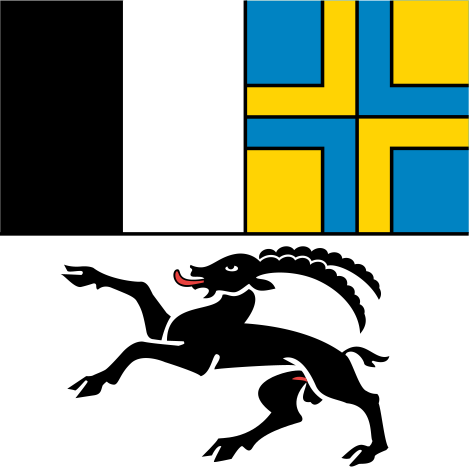
- History: Graubünden grew out of three leagues: the League of God’s House, the Grey League and the League of the Ten Jurisdictions. In 1797 it lost the Valtellina, Bormio and Chiavenna, and in 1803 it became a canton. The coat of arms combines the arms of the three leagues, and the ibex is the canton’s symbol.
- Nature: Graubünden borders Austria, Italy and Liechtenstein. The Anterior and Posterior Rhine join at Reichenau to form the Rhine, and the Inn flows via the Danube into the Black Sea. The highest mountain is Piz Bernina. The Swiss National Park, founded in 1914, lies in the Engadine, and the Ruinaulta gorge is called the «Swiss Grand Canyon».
- Culture: The Albula and Bernina lines of the Rhaetian Railway and the Convent of St. John in Müstair are UNESCO World Heritage Sites. On 1 March children chase away winter at Chalandamarz, Heidi is set near Maienfeld, the WEF meets in Davos, and St. Moritz hosted the Olympics in 1928 and 1948. Nut tart (Nusstorte), capuns and Bündnerfleisch (air-dried beef) are well known. Tourism is a key part of the economy.
The naturalisation process in the canton of Graubünden
The Office for Migration and Civil Law pre-checks the application and forwards it to the burgher community. The burgher community holds the test or the interview and decides on municipal citizenship. After the permit from the State Secretariat for Migration (SEM), the canton grants cantonal citizenship.
B1 spoken and A2 written in German, Romansh or Italian are required. The residence rule is five years in the municipality, the last two without interruption. The fees of the canton and the burgher community together amount to at most about 2000 francs per person, plus the federal fee.
How to prepare
The information sheet of the Office for Migration and Civil Law recommends the booklet «ECHO – Information zur Schweiz» by HEKS. Also ask your burgher community whether it holds a written test and which material it recommends.
Because the burgher community also asks local questions, it pays to know your municipality well: history, customs, authorities and which language is traditionally spoken there. In a trilingual canton, interest in the local language and culture says a lot about your integration.
With the practice questions and the mock test on this page you can check your basic knowledge before the test or interview.
Residence requirement
In the canton of Graubünden (Grisons) you must have lived 5 years in the commune, the last 2 of them without interruption before you apply.
On top of that come the federal requirements: a C permit and 10 years in Switzerland in total, 3 of them in the 5 years before you apply. Years between your 8th and 18th birthday count double, but you must actually have lived here for at least 6 years.
Source: Federal Council report of 5 November 2025 (Art. 4 Abs. 1 KBüG GR)
Costs
Canton and Bürgergemeinde together at most about CHF 2000, plus Confederation.
On top of the cantonal and communal fees comes the federal fee: CHF 100 for an adult, CHF 150 for a married couple applying together and CHF 50 for a minor.
Sample questions about Graubünden (Grisons)
Test yourself: tap an answer to see the solution and the explanation.
What is the capital of the Canton of Graubünden?
Show answer
Correct answer: C – Chur
Chur is the capital and largest town of the canton. The government, the Grand Council (Grosser Rat) and the cantonal administration are based there.
Source: de.wikipedia.org · Checked October 2026
Which town is considered the oldest town in Switzerland?
Show answer
Correct answer: A – Chur
Chur is considered the oldest town in Switzerland; the area has been settled for thousands of years. In Roman times the place was called Curia. Bern, Lucerne and St. Gallen only developed in the Middle Ages.
Source: de.wikipedia.org · Checked October 2026
Roughly how many inhabitants does Graubünden have?
Show answer
Correct answer: B – About 200,000
At the end of 2025, about 207,400 people were permanently resident in the canton (FSO, as of 2026). Despite having the largest area of all cantons, Graubünden is therefore sparsely populated.
Source: bfs.admin.ch · Checked October 2026
Official documents
These documents are published by the canton, the communes or their test providers. If anything differs, the authority’s information applies.
- InformationMerkblatt zur ordentlichen Einbürgerung von ausländischen Staatsangehörigen im Kanton Graubünden (AFM)gr.ch
- InformationOrdentliche Einbürgerung von Ausländerinnen und Ausländern (Amt für Migration und Zivilrecht)gr.ch
- InformationBürgerrechtsgesetz des Kantons Graubünden (KBüG, BR 130.100)gr-lex.gr.ch
- Study materialEmpfohlene Lektüre gemäss AFM-Merkblatt: ECHO - Informationen zur Schweiz (HEKS)heks.ch
Frequently asked questions
Is there a cantonal citizenship test in Graubünden?
No. The burgher community, or the political municipality where there is no burgher community, checks basic knowledge itself: with a written test or in the naturalisation interview, which takes place in every case. There is no cantonal question catalogue.
In which language can I provide my language certificate?
In any of the canton's three languages: German, Romansh or Italian. B1 spoken and A2 written are required.
Do certificates from private naturalisation courses count?
No. The cantonal Office for Migration and Civil Law points out that certificates from private naturalisation courses are not taken into account.
Cantons with the same test form
 Lucerne
 Schwyz
 St. Gallen
 Thurgau
 Valais