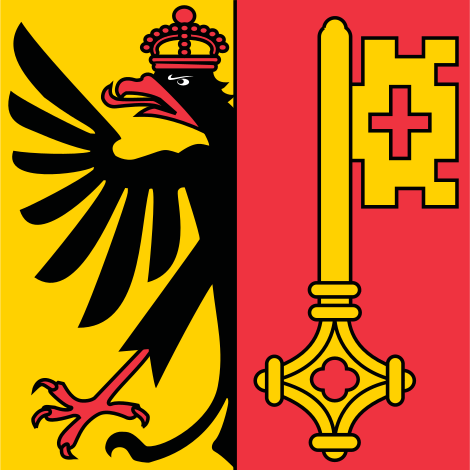
How the Geneva test works
Geneva checks basic knowledge with a written test taken at a session at the cantonal naturalisation service, before you apply. The certificate is a prerequisite for applying and does not expire. If you fail, you can retake it at a later session. You register through the Service des naturalisations.
According to the cantonal regulations, the test covers the geography, history, customs, religions and public holidays of Switzerland and Geneva, as well as political and social aspects, democracy, federalism, and rights and duties. The number of questions and the pass mark are not officially published. Unofficial reports mention about 45 minutes and 45 to 50 multiple-choice or true/false questions.
After you apply comes an interview with an investigator. It checks your civic knowledge and your interest in your municipality, the canton and Switzerland with specific questions.
Who is exempt
Exempt are children under 12, people born in Geneva who have lived here continuously, and people under 25 with five years of compulsory schooling or upper secondary or tertiary education in Geneva. Anyone aged 12 to 25 who is not exempt takes a simplified test during the interview.
What you should know about the canton of Geneva
- International city: Geneva has about 537,000 inhabitants, around 40 percent hold a foreign passport, and about 180 nationalities live here. Geneva hosts the UN Office, the ICRC, the WHO, the WTO and many other organisations. CERN is in Meyrin.
- Structure: The canton has 45 municipalities and no districts. The city of Geneva is run by a five-member Conseil administratif. Its only neighbouring canton is Vaud; most of the border is with France.
- Authorities: The Grand Conseil has 100 members and the Conseil d’État seven. Since the 2012 constitution both have been elected for five years. They meet in the Hôtel de Ville in the old town, where the first Geneva Convention was signed in 1864. The presidency of the Conseil d’État changes every year. The highest court is the Cour de justice. The constitution provides for compulsory education or training until age 18.
- People’s rights: A legislative initiative needs 1.5 percent of voters within four months, and you have 40 days for a referendum. Foreign nationals aged 18 and over with eight years in Switzerland may vote, elect and sign at municipal level.
- History: Julius Caesar was the first to mention Geneva. John Calvin arrived in 1536 and made Geneva the «Protestant Rome». On the night of 11 to 12 December 1602 Geneva repelled the Savoyard attack, the Escalade. From 1798 to 1813 Geneva was French, and the Restoration of the Republic is celebrated on 31 December. Geneva joined the Confederation in 1815, and the League of Nations settled here in 1920. Henri Dunant, Jean-Jacques Rousseau and General Dufour were Genevans.
- Symbols and culture: The landmark is the Jet d’eau, the Reformation Wall stands in the Parc des Bastions, and the motto is «Post Tenebras Lux». At the Escalade people break a chocolate marmite and sing «Cé qu’è lainô». The Jeûne genevois in September is a Geneva public holiday with plum tart. Specialities include longeole sausage and cardoons.
The naturalisation process in the canton of Geneva
First you pass the test, then you submit the application to the canton. The investigation follows with the interview, the municipality gives its opinion, and the State Secretariat for Migration (SEM) issues the federal permit. Finally the canton grants citizenship.
The residence rule is two years in the canton. For French you need B1 spoken and A2 written. The cantonal fee is 1250 francs from age 25, 850 francs under 25, 300 francs for minors aged 11 to 17 and 2000 francs for couples aged 25 and over, plus the federal fee.
How to prepare
Geneva offers some of the best study aids in Switzerland: the study programme «Connaître la Suisse et Genève» with five modules on history, Switzerland and the cantons, the political system, rights and duties, and customs, each with video, audio, PDF and quizzes. Then there is the questionnaire with 141 questions, with and without answers.
For the interview after the test, it pays to know Geneva from your own experience: have you been to the Escalade, do you know your municipality, its authorities and events? The canton also provides a guide to preparing for the interview.
With the practice questions and the mock test on this page you can check your knowledge. Since Geneva does not publish an official format, the mock test uses a practice format with 30 questions.
Residence requirement
In the canton of Geneva you must have lived 2 years in the canton before you apply.
On top of that come the federal requirements: a C permit and 10 years in Switzerland in total, 3 of them in the 5 years before you apply. Years between your 8th and 18th birthday count double, but you must actually have lived here for at least 6 years.
Source: Federal Council report of 5 November 2025 (Art. 17 Abs. 1 lit. b LDCG)
Costs
Canton CHF 1250 (age 25+), CHF 850 under 25; Confederation CHF 100.
On top of the cantonal and communal fees comes the federal fee: CHF 100 for an adult, CHF 150 for a married couple applying together and CHF 50 for a minor.
Sample questions about Geneva
Test yourself: tap an answer to see the solution and the explanation.
What is the capital of the canton of Geneva?
Show answer
Correct answer: C – Geneva
The capital of the canton is the city of Geneva, which is also the canton's largest municipality. The Conseil d'État and the Grand Conseil sit in the Hôtel de Ville in the Old Town. Carouge, Lancy and Vernier are other Geneva municipalities.
Source: ge.ch · Checked October 2026
In which text is Geneva first mentioned in writing?
Show answer
Correct answer: A – In a text by Julius Caesar
Geneva is first mentioned in Julius Caesar's 'Gallic War', in the 1st century BC. Caesar reports that he had the Geneva bridge cut to stop the Helvetii from crossing in 58 BC. Geneva was then a town of the Allobroges.
Source: ge.ch · Checked October 2026
What does Geneva's motto, 'Post Tenebras Lux', mean?
Show answer
Correct answer: A – After darkness, light
'Post Tenebras Lux' is a Latin phrase meaning 'After darkness, light'. It became Geneva's motto at the time of the Reformation. It appears on the Geneva coat of arms and on the Reformation Wall.
Source: ge.ch · Checked October 2026
Official documents
These documents are published by the canton, the communes or their test providers. If anything differs, the authority’s information applies.
- Study materialDidacticiel « Connaître la Suisse et Genève » (5 modules vidéo/audio/PDF + quiz)ge.ch
- Study materialDidacticiel - page de téléchargement des PDF (modules Histoire, Suisse et cantons, Système politique, Droits et devoirs, Us et coutumes)ge.ch
- Question bankQuestionnaire (141 questions) avec réponsesge.ch
- Question bankQuestionnaire (141 questions) sans réponsesge.ch
- Study materialQuiz en ligne du didacticieloutils.ge.ch
- InformationNaturalisation ordinaire - dépôt d'une demande (test préalable, émoluments)ge.ch
- InformationPréparer l'entretien de naturalisationge.ch
- InformationRèglement d'application de la loi sur la nationalité genevoise (art. 18-21 : test de connaissances générales)silgeneve.ch
Frequently asked questions
Do I have to pass a test before applying in Geneva?
Yes. The certificate confirming that you passed the test is a prerequisite for submitting an ordinary naturalisation application. It does not expire. If you fail, you can retake it at a later session.
How many questions does the Geneva test have?
The number of questions and the pass mark are not officially published; they are set in an internal directive. Unofficial reports mention about 45 minutes and 45 to 50 questions.
What can I prepare with?
With the canton's study programme «Connaître la Suisse et Genève» (five modules with video, audio, PDF and quizzes) and the questionnaire with 141 questions, available with and without answers.
Cantons with the same test form
 Zurich
 Bern
Bern Uri
Uri Obwalden
 Appenzell Outer Rhodes
 Aargau
 Vaud
Vaud