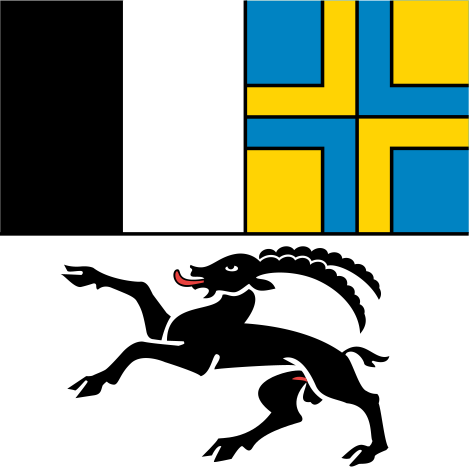
Flag of the canton of Graubünden (Grisons)

Questions about Graubünden (Grisons)

24 practice questions with answers and explanations on the authorities, history, geography and culture of Graubünden (Grisons). The app has all 413 questions on Graubünden (Grisons) and Switzerland.

Graubünden (Grisons) does not publish an official question bank. Our questions are based on the study material of the canton and the Confederation and cover the topics that are examined.

Tap an answer to see if it is right. Under “Show answer” you find the solution with an explanation and the source.

Politics and the state

How many members does the Grand Council (Grosser Rat), the cantonal parliament of Graubünden, have?

Show answer

Correct answer: D – 120

The Grand Council has 120 members (Art. 27 of the cantonal constitution) and is elected every four years, most recently on 14 June 2026. It meets in Chur.

Source: gr-lex.gr.ch · Checked October 2026

Under which electoral system has the Grand Council of Graubünden been elected since 2022?

Show answer

Correct answer: B – Proportional representation (biproportional method)

On 13 June 2021 voters approved the introduction of proportional representation. In 2022 the Grand Council was elected for the first time using the 'double Pukelsheim' method, and in 2026 for the second time. Before that, the majority system applied, which the Federal Supreme Court had found partly unconstitutional in 2019.

Source: gr.ch · Checked October 2026

How many members does the government (Regierung) of Graubünden have?

Show answer

Correct answer: B – 5

The government consists of five members (Art. 38 of the cantonal constitution), each heading a department. It is elected by the people by majority vote for four years, most recently on 14 June 2026.

Source: gr-lex.gr.ch · Checked October 2026

History

Which town is considered the oldest town in Switzerland?

Show answer

Correct answer: A – Chur

Chur is considered the oldest town in Switzerland; the area has been settled for thousands of years. In Roman times the place was called Curia. Bern, Lucerne and St. Gallen only developed in the Middle Ages.

Source: de.wikipedia.org · Checked October 2026

Since when has Romansh been a national language of Switzerland?

Show answer

Correct answer: C – Since 1938

In a popular vote in 1938, Romansh was recognised as the fourth national language. Since 1996 it has also been a partial official language of the Confederation (for dealings with Romansh speakers).

Source: liarumantscha.ch · Checked October 2026

From which three leagues did Graubünden originate?

Show answer

Correct answer: B – League of God's House, Grey League and League of the Ten Jurisdictions

In the 14th and 15th centuries the League of God's House (1367), the Grey League (1395) and the League of the Ten Jurisdictions (1436) were formed. They joined together as the Free State of the Three Leagues. The name Graubünden comes from the Grey League.

Source: hls-dhs-dss.ch · Checked October 2026

In which year did Graubünden become a canton of the Swiss Confederation?

Show answer

Correct answer: A – 1803

With Napoleon's Act of Mediation, Graubünden became a full canton in 1803. Before that, the Free State of the Three Leagues was only an ally of the Confederation (an 'associated place').

Source: de.wikipedia.org · Checked October 2026

Geography

What is the capital of the Canton of Graubünden?

Show answer

Correct answer: C – Chur

Chur is the capital and largest town of the canton. The government, the Grand Council (Grosser Rat) and the cantonal administration are based there.

Source: de.wikipedia.org · Checked October 2026

Into how many regions has the Canton of Graubünden been divided since 2016?

Show answer

Correct answer: D – 11

Since 1 January 2016, 11 regions have replaced the former districts and circles (Kreise). Examples are Plessur, Surselva, Maloja, Moesa and Prättigau/Davos.

Source: gr.ch · Checked October 2026

How many political municipalities does the Canton of Graubünden have (as of 2026)?

Show answer

Correct answer: B – 100

Numerous mergers have sharply reduced the number of municipalities; in the early 2000s there were still more than 200. Since 1 January 2025 there have been 100 (as of 2026). Most recently, Tschiertschen-Praden merged with Chur.

Source: gr.ch · Checked October 2026

Which canton is the largest in Switzerland by area?

Show answer

Correct answer: D – Graubünden

Graubünden is the largest canton in Switzerland, at about 7,100 km². It contains around 150 valleys.

Source: de.wikipedia.org · Checked October 2026

Society and everyday life

Roughly how many inhabitants does Graubünden have?

Show answer

Correct answer: B – About 200,000

At the end of 2025, about 207,400 people were permanently resident in the canton (FSO, as of 2026). Despite having the largest area of all cantons, Graubünden is therefore sparsely populated.

Source: bfs.admin.ch · Checked October 2026

What are the official languages of the Canton of Graubünden?

Show answer

Correct answer: A – German, Romansh and Italian

According to the cantonal constitution (Art. 3), German, Romansh and Italian are the canton's equal national and official languages. Graubünden is Switzerland's only trilingual canton.

Source: gr-lex.gr.ch · Checked October 2026

In which valley of Graubünden is Italian mainly spoken?

Show answer

Correct answer: B – In the Val Poschiavo

Italian is the language of Graubünden's southern valleys: Mesolcina, Calanca, Bregaglia and Val Poschiavo. The Surselva, by contrast, is largely Romansh-speaking, while the Prättigau and Schanfigg are German-speaking.

Source: de.wikipedia.org · Checked October 2026

What is the name of the umbrella organisation promoting the Romansh language and culture?

Show answer

Correct answer: D – Lia Rumantscha

The Lia Rumantscha was founded in 1919 and works to preserve and promote Romansh. It is based in Chur.

Source: liarumantscha.ch · Checked October 2026

Everyday life

In Graubünden, who assesses familiarity with local conditions in ordinary naturalization?

Show answer

Correct answer: C – The citizens' community (or municipality)

After the preliminary check by the Office for Migration and Civil Law, the canton forwards the application to the citizens' community (Bürgergemeinde), or to the political municipality where none exists. It carries out the further checks and conducts the naturalization interview.

Source: gr.ch · Checked October 2026

How is basic knowledge of Switzerland, the canton and the municipality tested in Graubünden?

Show answer

Correct answer: A – With a written test or in the naturalization interview

The citizens' community or municipality tests basic knowledge with a written test or as part of the naturalization interview, which takes place in every case. According to the canton's information sheet, certificates from private naturalization courses are not taken into account.

Source: gr.ch · Checked October 2026

What language skills does Graubünden require for naturalization?

Show answer

Correct answer: D – B1 spoken and A2 written in a cantonal language

Level B1 spoken and level A2 written are required in one of the cantonal languages. This can be German, Romansh or Italian.

Source: gr.ch · Checked October 2026

Economy

What is Bündnerfleisch?

Show answer

Correct answer: C – Air-dried beef

Bündnerfleisch is seasoned, air-dried beef. It is a protected geographical indication (PGI/IGP) and is served thinly sliced.

Source: de.wikipedia.org · Checked October 2026

Which economic sector is particularly important for Graubünden?

Show answer

Correct answer: A – Tourism

With places such as St. Moritz, Davos, Arosa, Flims-Laax and Lenzerheide, tourism is a key sector. Hydropower, construction and agriculture are also important.

Source: de.wikipedia.org · Checked October 2026

Culture

What is the name of the common written form of Romansh created in 1982?

Show answer

Correct answer: D – Rumantsch Grischun

Rumantsch Grischun was developed in 1982 by the linguist Heinrich Schmid on behalf of the Lia Rumantscha. In addition there are five regional written idioms, including Sursilvan and Vallader.

Source: liarumantscha.ch · Checked October 2026

How many regional written idioms does Romansh have?

Show answer

Correct answer: C – Five

The five idioms are Sursilvan, Sutsilvan, Surmiran, Puter and Vallader. Puter and Vallader are spoken in the Engadine.

Source: liarumantscha.ch · Checked October 2026

Which Rhaetian Railway lines have been a UNESCO World Heritage Site since 2008?

Show answer

Correct answer: D – The Albula and Bernina lines

The Rhaetian Railway's Albula and Bernina lines have been UNESCO World Heritage since 2008. A famous landmark is the Landwasser Viaduct near Filisur.

Source: whc.unesco.org · Checked October 2026

Which monastery in Graubünden with Carolingian frescoes is a UNESCO World Heritage Site?

Show answer

Correct answer: A – Convent of St John in Müstair

The Benedictine Convent of St John in the Val Müstair dates back to the late 8th century and has been a UNESCO World Heritage Site since 1983. Its wall paintings are among the most important of the early Middle Ages.

Source: whc.unesco.org · Checked October 2026

All questions by topic

The test also includes questions about Switzerland as a whole. Practise them by topic: