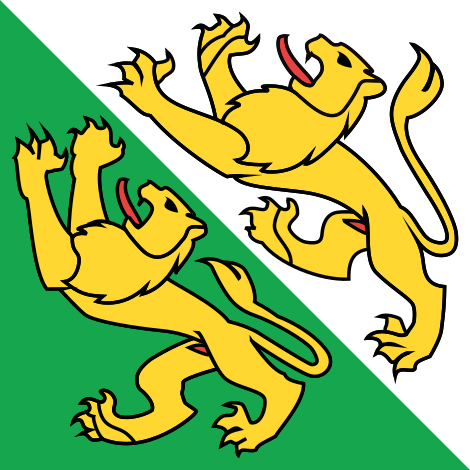
How Thurgau checks your knowledge
In Thurgau the check lies with the municipality. Under the cantonal Citizenship Act, knowledge of local, cantonal and Swiss living conditions is assessed by a test or in an interview, unless it is evident. Usually the naturalisation committee holds a personal interview, and many municipalities also have their own written basic knowledge test.
There is no uniform cantonal test and no cantonal question catalogue. In 2014 the Regierungsrat stated that the canton is not responsible for this. Municipalities may require the course «Die Schweiz kennen und verstehen – Attest Grundwissen» at the GBW Weinfelden. Questions about the municipality and the district are part of it.
What you should know about the canton of Thurgau
- Structure: The capital is Frauenfeld. Since 2011 the canton has had five districts: Arbon, Frauenfeld, Kreuzlingen, Münchwilen and Weinfelden, plus 80 political municipalities and about 300,000 inhabitants. The 1987 constitution abolished the dual municipal system. In federal votes, Swiss citizens abroad count as the «81st municipality».
- Authorities: The Grosser Rat has 130 members and meets in Frauenfeld in summer and in Weinfelden in winter. The districts are its constituencies. The Regierungsrat has five members and is elected by the people by majority vote. The highest courts are the Obergericht and the administrative court. The current constitution has applied since 1990.
- People’s rights: An initiative needs 4000 voters, a referendum 2000 within three months. 30 members of the Grosser Rat can also demand a popular vote. Constitutional amendments always go to the people.
- History: In 1460 the Confederates conquered Thurgau, which then remained a jointly ruled subject territory until 1798. It gained its freedom in March 1798 and became a canton in 1803. From 1713 to 1797 the Federal Diet (Tagsatzung) met in Frauenfeld. The 1869 constitution brought direct democracy, and in 1875 Fridolin Anderwert became the first Federal Councillor from Thurgau.
- Geography: Thurgau lies on Lake Constance and the Untersee and borders Germany as well as Schaffhausen, Zurich and St. Gallen. The river Thur gave it its name, and the highest point is the Hohgrat.
- Economy and culture: Because of its many fruit trees, the canton is jokingly called «Mostindien» (cider India). Stadler Rail has its headquarters in Bussnang. Arenenberg Castle houses the Napoleon Museum, the Ittingen Charterhouse the Thurgau Art Museum, and Kreuzlingen the University of Teacher Education.
The naturalisation process in the canton of Thurgau
You submit the application to your political municipality. It checks your knowledge with a test or interview and grants municipal citizenship. Then comes the federal naturalisation permit from the State Secretariat for Migration (SEM). Cantonal citizenship is conferred by the Grosser Rat.
Thurgau requires German at B2 spoken and B1 written, more than the federal minimum. The residence rule is five years in the canton, the last three without interruption in the municipality. Cantonal citizenship costs 800 francs for adults and 400 francs up to age 18, plus municipal and federal fees.
How to prepare
The State Chancellery publishes the «Kurzbiografie Kanton Thurgau» (42nd edition, 2026) as official civics study material. «Thurgau in Zahlen 2026» and the information sheet of the Office for the Commercial Register and Civil Status on the procedure are useful additions.
Ask your municipality whether it has its own test or requires the GBW course. Because the interview is held at German level B2, you should be able to understand more complex questions and answer in detail. Also practise local topics: your district, municipal authorities and what makes your municipality special.
With the practice questions and the mock test on this page you can check your knowledge before the test or interview.
Residence requirement
In the canton of Thurgau you must have lived 5 years in the canton, the last 3 of them without interruption in the commune before you apply.
On top of that come the federal requirements: a C permit and 10 years in Switzerland in total, 3 of them in the 5 years before you apply. Years between your 8th and 18th birthday count double, but you must actually have lived here for at least 6 years.
Source: Federal Council report of 5 November 2025 (§ 4 Abs. 1 KBüG TG)
Costs
Canton CHF 800 per adult, commune per its tariff, Confederation CHF 100.
On top of the cantonal and communal fees comes the federal fee: CHF 100 for an adult, CHF 150 for a married couple applying together and CHF 50 for a minor.
Sample questions about Thurgau
Test yourself: tap an answer to see the solution and the explanation.
What is the capital of the Canton of Thurgau?
Show answer
Correct answer: C – Frauenfeld
Frauenfeld is the cantonal capital; the Government Council meets in the government building there. Kreuzlingen and Arbon are also important towns in Thurgau.
Source: tg.ch · Checked October 2026
In which year was the number of Thurgau districts reduced from eight to five?
Show answer
Correct answer: D – 2011
With the 2011 judicial reform, the number of districts was reduced from eight to five. The former 8 districts and 31 circles were a legacy of the Napoleonic era.
Source: tg.ch · Checked October 2026
How are Swiss citizens abroad counted in Thurgau in federal elections and votes?
Show answer
Correct answer: D – As the '81st municipality'
Swiss citizens abroad whose place of origin or last residence is in Thurgau form the '81st municipality' in federal elections and votes. The canton itself has 80 political municipalities.
Source: tg.ch · Checked October 2026
Official documents
These documents are published by the canton, the communes or their test providers. If anything differs, the authority’s information applies.
- Study materialKurzbiografie Kanton Thurgau - Der Staat, seine Behörden, seine Aufgaben (Staatskanzlei, 42. Auflage 2026)tg.ch
- Study materialThurgau in Zahlen 2026 (Amt für Daten und Statistik)statistik.tg.ch
- InformationMerkblatt: Wie werde ich Schweizer Bürger/in? Verfahrensablauf bei der ordentlichen Einbürgerung (Amt HZ, 07/2023)hz.tg.ch
- InformationOrdentliche Einbürgerung (Amt für Handelsregister und Zivilstandswesen)hz.tg.ch
- Study materialGBW Weinfelden: Kurs «Die Schweiz kennen und verstehen - Attest Grundwissen» (von manchen Gemeinden verlangt/anerkannt)gbw.ch
Frequently asked questions
Is there a cantonal citizenship test in Thurgau?
No. The municipal authority, usually the naturalisation committee, checks knowledge with a test or in an interview. Many municipalities have their own written test. There is no cantonal question catalogue.
What level of German does Thurgau require?
Thurgau requires more than the federal minimum: B2 spoken and B1 written.
How much does naturalisation cost in Thurgau?
Cantonal citizenship costs 800 francs per adult and 400 francs up to age 18; children naturalised with their parents are free. Municipal and federal fees come on top.
Cantons with the same test form
 Lucerne
 Schwyz
 St. Gallen
 Graubünden (Grisons)
 Valais