How the Neuchâtel test works
Neuchâtel checks basic knowledge orally in the integration interview at the Service de la cohésion multiculturelle (COSM). You are asked 16 questions, four per topic: geography, history, politics and society. At least one question per topic concerns the canton of Neuchâtel. You pass with at least 10 correct answers. Important: partly correct answers count as wrong.
All possible questions come from the COSM’s public questionnaire, available with and without answers and last updated in June 2026. The questionnaire also contains an open question about your municipality. There is no separate test fee.
Who is exempt
For ordinary naturalisation you are exempt if you attended compulsory school in Switzerland for at least five years, hold a Swiss upper secondary qualification or have completed the course «Vivre en Suisse et à Neuchâtel : connaissances civiques». In facilitated naturalisation you are always questioned orally.
What you should know about the canton of Neuchâtel
- Structure: The capital is Neuchâtel, on the lake of the same name. Since 2018 four regions have replaced the districts: Littoral, Montagnes, Val-de-Ruz and Val-de-Travers. Since 2025 there have been only 24 municipalities, and the canton has about 180,000 inhabitants. The official language is French.
- Authorities: The Grand Conseil has 100 members and meets in Neuchâtel Castle; the Conseil d’État has five. Both are elected for four years. The constitution dates from 2000 and declares the canton a secular republic: there is no state religion, and freedom of religion is guaranteed.
- People’s rights: A legislative initiative needs 4500 signatures within six months, a referendum 4500 within 90 days. Foreign nationals with a C permit and five years in the canton may vote at cantonal level, but can only be elected to municipal bodies. Neuchâtel and Jura are the only cantons where foreign nationals can vote at cantonal level.
- History: Neuchâtel was admitted to the Confederation on 12 September 1814 and was both a canton and a Prussian principality until 1848. The republic was proclaimed on 1 March 1848, and in 1857 the King of Prussia finally renounced his rights. Guillaume Farel introduced the Reformation in 1530, Huguenots found refuge here, and in 1871 the Bourbaki army crossed into Switzerland at Les Verrières.
- Geography: Lake Neuchâtel is the largest lake lying entirely in Switzerland. The Creux-du-Van rock amphitheatre is near the Val-de-Travers, and the Doubs forms the border with France. La Chaux-de-Fonds is the largest Swiss town above 1000 metres.
- Culture and economy: The watch industry shapes the canton; La Chaux-de-Fonds and Le Locle are a UNESCO World Heritage Site for their watchmaking town planning. Le Corbusier and Louis Chevrolet came from La Chaux-de-Fonds. The Val-de-Travers is considered the birthplace of absinthe, and Suchard invented Sugus sweets in 1931. The Federal Statistical Office is based in Neuchâtel, and the Fête des Vendanges (grape harvest festival) is held at the end of September.
The naturalisation process in the canton of Neuchâtel
The COSM and the municipality carry out the assessments, and the integration interview with the 16 questions takes place at the COSM. After the permit from the State Secretariat for Migration (SEM), the canton grants citizenship.
The residence rule is two years in the canton. Fees total 1750 francs for an adult (of which 1500 francs go to the canton), 850 francs for minors and 2250 francs for married couples. For French you need at least B1 spoken and A2 written.
How to prepare
Download the COSM questionnaire with answers and learn it thoroughly, because all the questions come from it. Since partly correct answers count as wrong, you should be able to give complete answers, for example all four regions rather than just two. The optional course lasts six weeks, three hours each week, and costs 150 francs. Anyone who completes it is exempt from the questions in ordinary naturalisation.
Practise the answers out loud in French, because the questions are asked orally. Also prepare the open question about your municipality: what makes it special, who runs it, what happens there?
The Neuchâtel mock test on this page has the same format: 16 questions, passed with 10 correct. Ours are multiple-choice questions; in the real interview you answer freely.
Residence requirement
In the canton of Neuchâtel you must have lived 2 years in the canton before you apply.
On top of that come the federal requirements: a C permit and 10 years in Switzerland in total, 3 of them in the 5 years before you apply. Years between your 8th and 18th birthday count double, but you must actually have lived here for at least 6 years.
Source: Federal Council report of 5 November 2025 (Art. 14 lit. b LDCN)
Costs
CHF 1750 in total for an adult; optional course CHF 150.
On top of the cantonal and communal fees comes the federal fee: CHF 100 for an adult, CHF 150 for a married couple applying together and CHF 50 for a minor.
Sample questions about Neuchâtel
Test yourself: tap an answer to see the solution and the explanation.
What is the capital of the canton of Neuchâtel?
Show answer
Correct answer: C – Neuchâtel
The capital of the canton is the town of Neuchâtel, on the lake of the same name. The Grand Conseil and the Conseil d'État sit there, in the castle. La Chaux-de-Fonds and Le Locle are the main towns of the Neuchâtel mountains.
Source: ne.ch · Checked October 2026
In which year did Neuchâtel join the Swiss Confederation?
Show answer
Correct answer: C – 1814
Neuchâtel was admitted to the Confederation on 12 September 1814, then confirmed as a canton by the Federal Pact of 1815 and the Congress of Vienna. Together with Geneva and Valais it was among the last cantons to join in the 19th century. However, it remained a principality of the King of Prussia.
Source: ne.ch · Checked October 2026
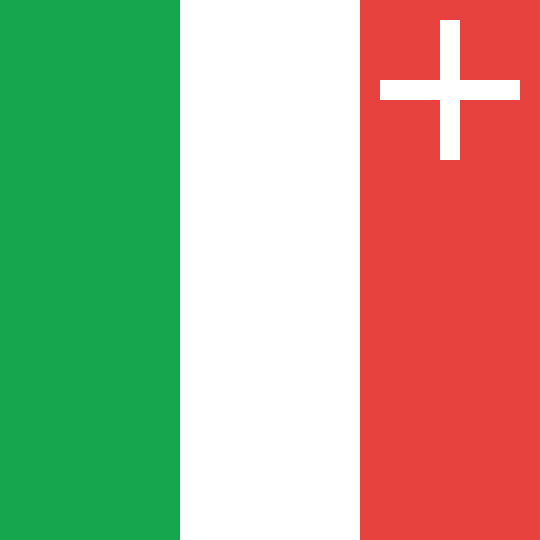
What does the flag of the canton of Neuchâtel look like?
Show answer
Correct answer: D – Three vertical stripes, green, white and red, with a white cross
The Neuchâtel flag is a vertical tricolour of green, white and red, with a small white cross in the upper part of the red field. It was adopted in 1848, after the Republic was proclaimed. According to one interpretation, green stands for the mountains, white for the farming area and red for the vineyards.
Source: fr.wikipedia.org · Checked October 2026
Official documents
These documents are published by the canton, the communes or their test providers. If anything differs, the authority’s information applies.
- Question bankQuestionnaire pour les candidat-e-s à la naturalisation - avec réponses (COSM, mise à jour juin 2026)ne.ch
- Question bankQuestionnaire pour les candidat-e-s à la naturalisation - sans réponses (COSM)ne.ch
- InformationPréparation à la naturalisation (cours « Vivre en Suisse et à Neuchâtel », format du test)ne.ch
- InformationNaturalisation - procédure et émolumentsne.ch
- InformationDroit de vote et d'éligibilité (Suisses et étrangers)ne.ch
Frequently asked questions
How many questions are asked in Neuchâtel?
16 questions, 4 each on geography, history, politics and society. At least one question per topic concerns the canton of Neuchâtel. You need at least 10 correct answers; partly correct answers count as wrong.
Can I study the questions beforehand?
Yes. All possible questions come from the COSM questionnaire, available with and without answers (updated in June 2026). It also contains an open question about your municipality.
Who is exempt from the questions?
For ordinary naturalisation, anyone who attended compulsory school in Switzerland for at least five years, holds a Swiss upper secondary qualification or has completed the course «Vivre en Suisse et à Neuchâtel» is exempt. In facilitated naturalisation, you are always questioned orally.
Cantons with the same test form
 Nidwalden
 Glarus
 Zug
Zug Fribourg
 Basel-City
 Basel-Country
 Schaffhausen
 Appenzell Inner Rhodes
 Jura
Jura