How Valais checks your knowledge
In Valais the check is a matter for the municipality. Its naturalisation committee asks written or oral questions it selects itself and invites you to a personal hearing. There is no cantonal scoring scheme. The cantonal guideline recommends that about a third of the questions deal with local or municipal topics, very much in the spirit of federalism.
The procedure has three levels: municipality, canton and Confederation. At the end, a subcommittee of the Grand Council hears you, and the Grand Council grants naturalisation.
For preparation, the Population and Migration Service publishes an official questionnaire with and without answers. It covers civic knowledge about Switzerland and Valais, the Confederation, canton and municipality, geography, customs, social and economic integration, and personal questions. There are versions from age 9, for 14- to 16-year-olds and for adults. Note: the questionnaire dates from 2021, and some answers are outdated, for example on the constitutional revision, which was rejected in 2024.
What you should know about the canton of Valais
- Two languages: French and German are official languages. French-speaking Lower and Central Valais form the majority, and Upper Valais speaks German. The language border is the Raspille stream between Sierre and Salgesch.
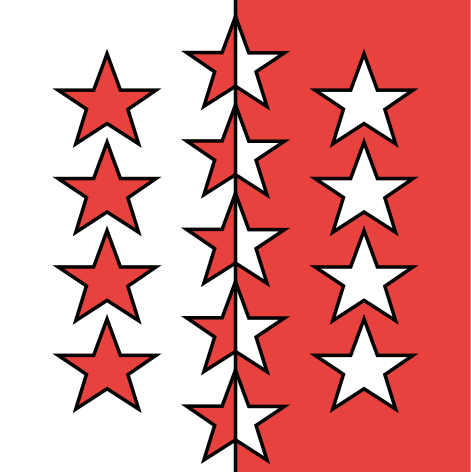
- Structure: The capital is Sion. Valais has 13 districts, represented by the 13 stars on the flag, and 122 municipalities (2026). Each district is represented by a prefect. The canton has about 371,000 inhabitants. Small municipalities decide at the primary assembly (assemblée primaire), large ones have a general council.
- Authorities: The Grand Council has 130 deputies and, as a Valais speciality, 130 substitutes who stand in for absent deputies. The Council of State has five members. Both are elected for four years. The president of the Grand Council is the «highest Valaisan». The cantonal court sits in Sion.
- Constitution: The current constitution dates from 1907. A new draft was rejected on 3 March 2024 with about 68 percent voting no.
- People’s rights: A legislative initiative needs 4000 signatures, a constitutional initiative 6000, both within twelve months. A referendum needs 3000 signatures within 90 days.
- History and geography: Valais joined the Confederation in 1815. The Rhône flows through the whole canton, and Switzerland’s highest mountain, the Dufourspitze, is here, as is the Aletsch Glacier. The Grande Dixence is the world’s tallest gravity dam. Valais borders France and Italy.
- Culture and economy: Typical are the cow fights of the Hérens breed, the Valais Blacknose sheep, the irrigation channels called bisses (Suonen), apricots, saffron from Mund and wines such as Petite Arvine. The Abbey of Saint-Maurice has existed since 515, and Valère and Tourbillon tower above Sion. Chemicals, hydropower and tourism, with resorts such as Zermatt, are important.
The naturalisation process in the canton of Valais
The application starts at the municipality, which checks your knowledge and grants municipal citizenship. The canton then reviews the file, the State Secretariat for Migration (SEM) issues the federal permit, and after the hearing before the subcommittee the Grand Council grants naturalisation.
The residence rule is five years in the canton and three years in the municipality. B1 spoken and A2 written are required. The municipal fee is at most 1000 francs (500 francs is recommended for single people and 1000 francs for couples or families), the canton charges 300 francs for single people or 500 francs for families plus a stamp duty of 55 francs, and the Confederation 100 francs.
How to prepare
Work through the official «Valais» questionnaire, ideally the version with answers. But check figures and current topics to make sure the answer is still correct. The questions on this page are up to date as of October 2026.
Set aside plenty of time for your municipality, because a third of the questions may be local: who is the mayor, is there a primary assembly or a general council, which festivals and traditions shape the place? In bilingual Valais, the procedure is held in the language of your municipality.
With the practice questions and the mock test on this page you can check your knowledge about Switzerland and Valais.
Residence requirement
In the canton of Valais you must have lived 5 years in the canton and 3 years in the commune before you apply.
On top of that come the federal requirements: a C permit and 10 years in Switzerland in total, 3 of them in the 5 years before you apply. Years between your 8th and 18th birthday count double, but you must actually have lived here for at least 6 years.
Source: Federal Council report of 5 November 2025 (Art. 3 Abs. 2 lit. b und Art. 1 Abs. 1 lit. a Gesetz über das Walliser Bürgerrecht)
Costs
Commune at most CHF 1000, canton CHF 300 (single adult), Confederation CHF 100.
On top of the cantonal and communal fees comes the federal fee: CHF 100 for an adult, CHF 150 for a married couple applying together and CHF 50 for a minor.
Sample questions about Valais
Test yourself: tap an answer to see the solution and the explanation.
What is the capital of the Canton of Valais?
Show answer
Correct answer: C – Sion
Sion (Sitten) is the capital of Valais and the seat of the Grand Council, the Council of State and the Cantonal Court. The town is dominated by the hills of Valère and Tourbillon.
Source: vs.ch · Checked October 2026
What does the flag of Valais look like?
Show answer
Correct answer: D – Half white, half red (vertical), with 13 stars
The Valais flag is divided vertically: white on the flagpole side, red on the other. The 13 stars are red on the white half and white on the red half.
Source: fr.wikipedia.org · Checked October 2026
Who represents the cantonal government in a Valais district?
Show answer
Correct answer: B – The prefect
Each Valais district is represented by a prefect. The prefect links the canton and the municipalities of the district.
Source: vs.ch · Checked October 2026
Official documents
These documents are published by the canton, the communes or their test providers. If anything differs, the authority’s information applies.
- Question bankQuestionnaire «Valais» - Naturalisation (non exhaustif, éventail de questions possibles; actualisation 17.05.2021)vs.ch
- Question bankQuestionnaire «Valais» - Naturalisation - RÉPONSES (actualisation 15.11.2021)vs.ch
- InformationGuide - Naturalisation ordinaire à l'attention des communes valaisannes (LN 2018), SPMvs.ch
- InformationGuide pour les communes (SPM, version 2024)vs.ch
Frequently asked questions
How is knowledge checked in Valais?
The municipal naturalisation committee asks written or oral questions it selects itself and holds a personal hearing. Then comes a hearing before a subcommittee of the Grand Council.
Is there an official questionnaire?
Yes. The Population and Migration Service publishes the «Valais» questionnaire with and without answers, in versions for different age groups. It is a selection of possible questions, not an exhaustive list. Some answers from 2021 are outdated, for example on the constitutional revision.
How many questions concern the municipality?
The cantonal guideline recommends that about a third of the questions deal with local or municipal topics.
Cantons with the same test form
 Lucerne
 Schwyz
 St. Gallen
 Graubünden (Grisons)
 Thurgau