How the test works in the canton of Vaud
Vaud checks basic knowledge with a written multiple-choice test organised by your municipality. You take it on a computer (A-Vaud test) or on paper. The test has 48 questions, you have 60 minutes, and you pass with 70 percent, that is at least 34 correct answers. The test is in French.
The 48 questions are drawn at random, spread evenly across three levels, namely Switzerland, the canton, and the municipality and region, and across four topics: geography, history, politics and society. The big advantage: the whole catalogue is public. It consists of 128 questions about Switzerland and the canton and 32 local questions per municipality, 160 questions in total.
You have up to three written attempts. After three failures an oral examination may be ordered. The municipality may also hold a hearing focused on integration. Whether it is voluntary or compulsory is up to each Municipalité.
Who does not have to take the test
Exempt are people born in Switzerland who have lived here continuously, people with five years of compulsory schooling in Switzerland, people with a Swiss upper secondary qualification, and children under 12 when the application is submitted. These exemptions do not apply to federal facilitated naturalisation.
What you should know about the canton of Vaud
- Structure: The capital is Lausanne. Since 2008 Vaud has had ten districts, about 300 municipalities and about 864,000 inhabitants. The municipal executive is called the Municipalité and is led by the syndic (mayor).
- Authorities: The parliament is the Grand Conseil with 150 members, and the government is the Conseil d’État with seven. Both are elected for five years. The Conseil d’État sits in the Château Saint-Maire in Lausanne, and the new parliament building was inaugurated on 14 April 2017. The highest court is the cantonal court. The constitution came into force on 14 April 2003.
- People’s rights: An initiative needs 12,000 signatures within four months, a referendum 12,000 within 60 days. Foreign nationals with ten years in Switzerland and three years in the canton may vote, elect and stand for election at municipal level. Voters rejected an extension to the cantonal level on 30 November 2025.
- History: Until 1536 most of Vaud belonged to Savoy; then Bern conquered the land and introduced the Reformation, whose main reformer here was Pierre Viret. Major Davel tried to end Bernese rule in 1723 and was executed. Independence was proclaimed on 24 January 1798, and Vaud became a canton in 1803. The Grand Conseil met for the first time on 14 April 1803. In 1959 Vaud became the first canton to introduce women’s suffrage.
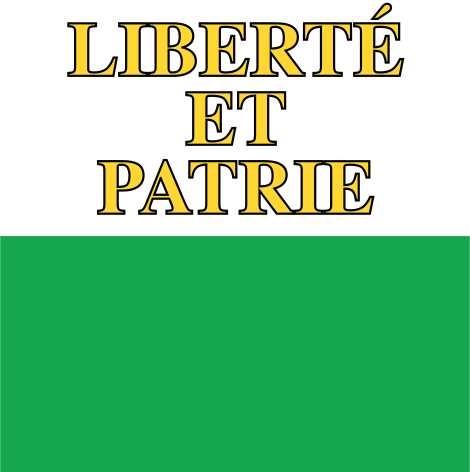
- Symbols: The flag is white at the top and green at the bottom, with the motto «Liberté et Patrie».
- Geography and culture: Lausanne lies on Lake Geneva, Yverdon-les-Bains on Lake Neuchâtel. The highest summit is Les Diablerets, the Lavaux vineyard terraces have been a UNESCO World Heritage Site since 2007, and Chillon Castle stands near Montreux. The Fête des Vignerons takes place in Vevey, the Paléo Festival in Nyon and the Jazz Festival in Montreux. The IOC has been based in Lausanne since 1915, Nestlé in Vevey, and EPFL is in Écublens. Papet vaudois (leeks with potatoes and sausage) is a typical dish.
The naturalisation process in the canton of Vaud
The application goes through your municipality, which organises the test and, if applicable, a hearing. After the decision on municipal citizenship, the canton reviews the file and forwards it to the State Secretariat for Migration (SEM). After federal approval, the canton grants cantonal citizenship.
The residence rule is two years in the canton, one of them in the municipality. For French you need at least B1 spoken and A2 written. Fees for an adult single person: municipality 100 to 400 francs, canton 450 plus 75 francs, Confederation 100 francs.
How to prepare
Use the official A-Vaud test on prestations.vd.ch: there you will find all 160 questions, including the 32 about your municipality. The canton also offers the «Didacticiel vaudois» for preparation. The municipality of Bex additionally publishes a copy of the cantonal questionnaire with answers.
Because 70 percent is required, you should really master the catalogue. Do not underestimate the municipal questions: they make up about a third of the test and differ for each municipality. Study them specifically with the A-Vaud test for your municipality.
The Vaud mock test on this page has the same format as the real test: 48 questions in 60 minutes, passed with 34 correct. Our questions are written by us; you will find the official ones in the linked A-Vaud test.
Residence requirement
In the canton of Vaud you must have lived 2 years in the canton, 1 of them in the commune before you apply.
On top of that come the federal requirements: a C permit and 10 years in Switzerland in total, 3 of them in the 5 years before you apply. Years between your 8th and 18th birthday count double, but you must actually have lived here for at least 6 years.
Source: Federal Council report of 5 November 2025 (Art. 12 Abs. 3 LDCV)
Costs
Commune CHF 100–400, canton CHF 525, Confederation CHF 100.
On top of the cantonal and communal fees comes the federal fee: CHF 100 for an adult, CHF 150 for a married couple applying together and CHF 50 for a minor.
Sample questions about Vaud
Test yourself: tap an answer to see the solution and the explanation.
What is the capital of the canton of Vaud?
Show answer
Correct answer: C – Lausanne
Lausanne is the capital of the canton of Vaud. The cantonal parliament (Grand Conseil) and government (Conseil d'État) sit there. Lausanne is also the largest town in the canton.
Source: bex.ch · Checked October 2026
According to tradition, what does the name 'Vaud' mean?
Show answer
Correct answer: B – The land of forests
The name Vaud is said to come from the Latin 'pagus waldensis', linked to the Germanic word 'wald', meaning forest. It therefore means 'land of forests'. The Pays de Vaud is mentioned as early as the early Middle Ages.
Source: bex.ch · Checked October 2026
What are the colours of the Vaud flag?
Show answer
Correct answer: D – White and green
The Vaud flag is white and green: the upper half is white, the lower half green. It was adopted in 1803, when the canton was born. Green was the colour of the Vaud Revolution and the Lemanic Republic of 1798.
Source: bex.ch · Checked October 2026
Official documents
These documents are published by the canton, the communes or their test providers. If anything differs, the authority’s information applies.
- InformationTest de connaissances (page officielle, liens A-Vaud-Test et didacticiel)vd.ch
- Question bankA-Vaud-Test - questionnaire dynamique officiel (160 questions Suisse/canton + questions locales)prestations.vd.ch
- Study materialDidacticiel vaudois pour la préparation à la naturalisationdidactnatu.vd.ch
- Question bankQCM officiel du Canton de Vaud (SPOP, mise à jour juillet 2021, 128 questions Suisse/canton, avec réponses) - copie publiée par la commune de Bexbex.ch
- InformationRèglement d'application de la loi sur le droit de cité vaudois (RLDCV, 141.11.1)lexfind.ch
- InformationÉmoluments de naturalisationvd.ch
Frequently asked questions
How many questions does the Vaud citizenship test have?
48 questions in 60 minutes. You pass with 70 percent, that is at least 34 correct answers. The questions are spread evenly across three levels (Switzerland, canton, municipality and region) and four topics (geography, history, politics, society).
Are the questions available in advance?
Yes. The catalogue contains 128 questions about Switzerland and the canton and 32 local questions per municipality, 160 questions in total. All are published in advance, for example in the official A-Vaud test.
How often can I retake the test?
You have up to three written attempts. After three failures an oral examination may be ordered.
In which language is the test held?
In French, the only official language of the canton of Vaud.
Cantons with the same test form
 Zurich
 Bern
Bern Uri
Uri Obwalden
 Appenzell Outer Rhodes
 Aargau
 Geneva