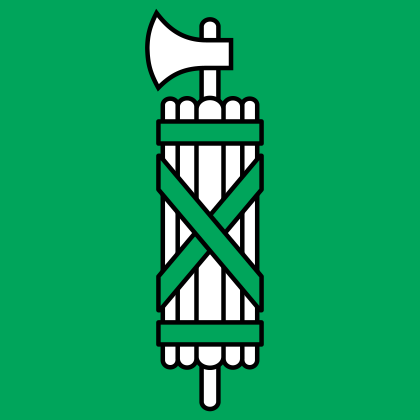
Flag of the canton of St. Gallen

Questions about St. Gallen

24 practice questions with answers and explanations on the authorities, history, geography and culture of St. Gallen. The app has all 411 questions on St. Gallen and Switzerland.

St. Gallen does not publish an official question bank. Our questions are based on the study material of the canton and the Confederation and cover the topics that are examined.

Tap an answer to see if it is right. Under “Show answer” you find the solution with an explanation and the source.

Politics and the state

What is the name of the parliament of the canton of St. Gallen and how many members does it have?

Show answer

Correct answer: B – Kantonsrat with 120 members

The St. Gallen parliament is called the Kantonsrat and consists of 120 members. They are elected every four years by proportional representation in the eight electoral districts. The Kantonsrat adopts the constitution, laws and the budget.

Source: gesetzessammlung.sg.ch · Checked October 2026

Where does the St. Gallen Kantonsrat meet?

Show answer

Correct answer: B – In the Pfalz building at the abbey courtyard

The Kantonsrat meets in the so-called Pfalz wing of the abbey courtyard in St. Gallen, i.e. in the Abbey District. The government also has its seat there. The Abbey District is a UNESCO World Heritage Site.

Source: de.wikipedia.org · Checked October 2026

How many members does the government of the canton of St. Gallen have?

Show answer

Correct answer: B – 7

The St. Gallen government consists of seven members, elected by the people by majority vote for four years. Each member heads one of the seven departments. The government decides as a collegial body.

Source: gesetzessammlung.sg.ch · Checked October 2026

History

In which year was the canton of St. Gallen founded?

Show answer

Correct answer: C – 1803

The canton of St. Gallen was created in 1803 by Napoleon's Act of Mediation from very different territories. It is one of the young cantons, together with Thurgau, Aargau, Vaud, Graubünden and Ticino. Karl Müller-Friedberg is regarded as its founder.

Source: arge.ch · Checked October 2026

What status did the Prince-Abbey and the city of St. Gallen have in the Confederation before 1798?

Show answer

Correct answer: C – They were 'associated places' (Zugewandte Orte), i.e. allies without full rights

The Prince-Abbey of St. Gallen including the Toggenburg and the city of St. Gallen were associated places of the Confederation. Other parts of today's canton were subject territories of Confederate cantons. Only after 1798 were the territories united to form the canton.

Source: arge.ch · Checked October 2026

When was women's suffrage introduced at cantonal and municipal level in the canton of St. Gallen?

Show answer

Correct answer: B – 1972

Women's right to vote and stand for election was introduced in St. Gallen at cantonal and municipal level in 1972, one year after its introduction at federal level (1971). Appenzell Inner Rhodes was the last canton to follow, in 1990. General male suffrage had existed since 1848.

Source: de.wikipedia.org · Checked October 2026

Which reformer was born in 1484 in Wildhaus in the Toggenburg?

Show answer

Correct answer: D – Huldrych (Ulrich) Zwingli

The Zurich reformer Huldrych Zwingli was born in 1484 in Wildhaus in the upper Toggenburg. He shaped the Reformation in German-speaking Switzerland. Calvin worked in Geneva, Luther in Germany.

Source: britannica.com · Checked October 2026

Geography

What is the capital of the canton of St. Gallen?

Show answer

Correct answer: A – St. Gallen

The cantonal constitution states: the capital is St. Gallen. With around 80,000 inhabitants, the city of St. Gallen is also the largest municipality. The second largest municipality is Rapperswil-Jona.

Source: gesetzessammlung.sg.ch · Checked October 2026

How many municipalities does the canton of St. Gallen have?

Show answer

Correct answer: B – 75

The canton of St. Gallen has 75 political communes (as of 2026). Their number keeps falling through mergers. There are also special communes such as local citizens’ communes (Ortsgemeinden) and school communes.

Source: agvchapp.bfs.admin.ch · Checked October 2026

Into how many electoral districts is the canton of St. Gallen divided?

Show answer

Correct answer: C – 8

The Kantonsrat is elected in eight electoral districts: St. Gallen, Rorschach, Rheintal, Werdenberg, Sarganserland, See-Gaster, Toggenburg and Wil. The electoral districts replaced the former districts in 2003. They have no administrative tasks of their own.

Source: gesetzessammlung.sg.ch · Checked October 2026

Which name is NOT an electoral district of the canton of St. Gallen?

Show answer

Correct answer: B – Thurgau

The eight electoral districts are St. Gallen, Rorschach, Rheintal, Werdenberg, Sarganserland, See-Gaster, Toggenburg and Wil. Thurgau is a separate neighbouring canton. It borders St. Gallen to the north.

Source: gesetzessammlung.sg.ch · Checked October 2026

Society and everyday life

Which university is located in the city of St. Gallen?

Show answer

Correct answer: C – The University of St. Gallen (HSG)

The University of St. Gallen (HSG) is particularly known for economics, law and social sciences. It is a cantonal university. ETH and EPFL are the two Federal Institutes of Technology in Zurich and Lausanne.

Source: de.wikipedia.org · Checked October 2026

Which religious communities are recognised under public law in the canton of St. Gallen?

Show answer

Correct answer: B – Catholics, Reformed, Christ Catholics and the Jewish community

Recognised under public law are the Catholic denomination (Katholischer Konfessionsteil), the Evangelical Reformed Church, the Christian Catholic Church and the Jewish community of St. Gallen. Because it was formed from different territories, the canton is mixed in terms of religion. Today a large part of the population belongs to neither of the two large churches.

Source: de.wikipedia.org · Checked October 2026

What is an Ortsgemeinde in the canton of St. Gallen?

Show answer

Correct answer: B – A special commune that manages e.g. forests and property

Besides the political municipalities, there are special municipalities in the canton of St. Gallen such as Ortsgemeinden, school municipalities and corporations. Ortsgemeinden provide charitable, cultural and other services and often manage forest and land. Their number is decreasing through mergers.

Source: arge.ch · Checked October 2026

Everyday life

Who conducts the civics test for naturalisation on behalf of many St. Gallen municipalities?

Show answer

Correct answer: D – Arge Integration Ostschweiz (Arge Bilang)

Many municipalities, including the city of St. Gallen, require a passed civics test from Arge Integration Ostschweiz. The tests take place, for example, in St. Gallen, Goldach, Wil, Uznach and Rapperswil-Jona. The results are forwarded to the responsible municipality.

Source: arge.ch · Checked October 2026

How much does the Arge Integration civics test for naturalisation in the city of St. Gallen cost?

Show answer

Correct answer: A – CHF 120

The city of St. Gallen states that the civics test costs 120 francs. On top of that come the naturalisation fees of the municipality, canton and Confederation and the costs of the language certificate. A preparatory civics course is voluntary in the city.

Source: stadt.sg.ch · Checked October 2026

How old may the certificate of a passed civics test be at most when submitting the application in the city of St. Gallen?

Show answer

Correct answer: B – 2 years

The test may have been taken at most two years before the naturalisation application is submitted. You can therefore take the test before applying. Tests from other providers are not accepted in the city of St. Gallen.

Source: stadt.sg.ch · Checked October 2026

Economy

Which economic sector was the most important in the canton of St. Gallen until about 1920?

Show answer

Correct answer: A – The textile industry with St. Gallen embroidery

Until about 1920, the textile industry, especially embroidery, was by far the most important industrial sector. St. Gallen lace and embroidery were exported all over the world. Today mechanical engineering, construction and services, among others, are important.

Source: de.wikipedia.org · Checked October 2026

Which regions in the canton of St. Gallen are particularly known for tourism with ski areas?

Show answer

Correct answer: B – The Sarganserland and the Obertoggenburg

In the Sarganserland and the Upper Toggenburg, tourism is important in summer and winter. Well-known ski areas are Flumserberg, Pizol and Obertoggenburg. In the city of St. Gallen, the abbey library and the cathedral attract many visitors.

Source: de.wikipedia.org · Checked October 2026

What is Bad Ragaz in the Sarganserland known for?

Show answer

Correct answer: C – Its thermal springs and spa resort

Bad Ragaz is a well-known spa resort with thermal water from the Tamina gorge. The Sarganserland is also an important tourist region with ski areas such as Pizol and Flumserberg. Bad Ragaz lies in the Sarganserland electoral district.

Source: de.wikipedia.org · Checked October 2026

Culture

What is the Abbey District (Stiftsbezirk) of St. Gallen?

Show answer

Correct answer: B – The former abbey precinct with cathedral and abbey library

The Abbey District with its Baroque cathedral, abbey library and abbey archive has been a UNESCO World Heritage Site since 1983. It goes back to the monastery that developed on the site of the hermitage of the monk Gallus. The abbey library holds valuable medieval manuscripts.

Source: sg.ch · Checked October 2026

After whom are the city and canton of St. Gallen named?

Show answer

Correct answer: A – The Irish monk Gallus

The name goes back to the wandering monk Gallus, who settled as a hermit by the Steinach river in the 7th century. The monastery of St. Gallen later developed on this site. The city grew from it.

Source: sg.ch · Checked October 2026

What does the coat of arms of the canton of St. Gallen show?

Show answer

Correct answer: D – A bundle of rods with an axe on a green field

The coat of arms shows a silver bundle of rods with an axe (fasces) on a green field. The bundle symbolises unity and harmony and recalls the founding of the canton in Napoleon’s time. Green was the colour of the Helvetic Republic.

Source: arge.ch · Checked October 2026

What is the OLMA in St. Gallen?

Show answer

Correct answer: B – The Swiss fair for agriculture and food, held in October

The OLMA has taken place in St. Gallen every October since 1943. It is the Swiss fair for agriculture and food and attracts hundreds of thousands of visitors. It is famous, for example, for the piglet race and the St. Gallen bratwurst.

Source: de.wikipedia.org · Checked October 2026

All questions by topic

The test also includes questions about Switzerland as a whole. Practise them by topic: