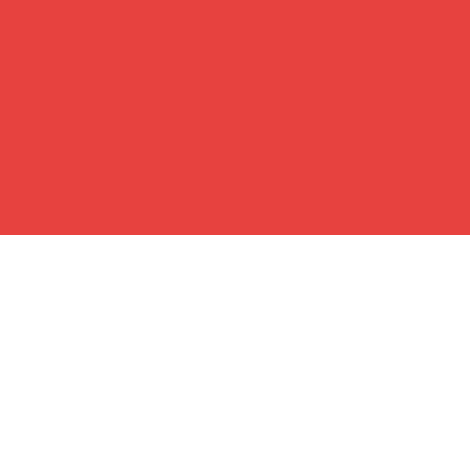
Flag of the canton of Solothurn

Questions about Solothurn

24 practice questions with answers and explanations on the authorities, history, geography and culture of Solothurn. The app has all 409 questions on Solothurn and Switzerland.

Solothurn does not publish an official question bank. Our questions are based on the study material of the canton and the Confederation and cover the topics that are examined.

Tap an answer to see if it is right. Under “Show answer” you find the solution with an explanation and the source.

Politics and the state

Into how many Amteien (administrative regions) is the canton of Solothurn divided?

Show answer

Correct answer: D – 5

According to the constitution the canton is divided into five Amteien, each with two districts: Solothurn-Lebern, Bucheggberg-Wasseramt, Thal-Gäu, Olten-Gösgen and Dorneck-Thierstein. The Amteien are the constituencies for the cantonal parliament.

Source: fedlex.data.admin.ch · Checked October 2026

How many districts does the canton of Solothurn have?

Show answer

Correct answer: B – 10

The five Amteien each consist of two districts, making ten districts in total. According to the constitution, administration and the courts are decentralised along the lines of the Amteien.

Source: fedlex.data.admin.ch · Checked October 2026

Approximately how many political municipalities (Einwohnergemeinden) does the canton of Solothurn have?

Show answer

Correct answer: C – Just over 100

Since 1 January 2026 the canton of Solothurn has had 104 municipalities (end of 2025: 106), after Halten and Oekingen merged with Kriegstetten. The number is slowly decreasing because of municipal mergers.

Source: de.wikipedia.org · Checked October 2026

From which year is the current constitution of the canton of Solothurn?

Show answer

Correct answer: B – 1986

The cantonal constitution was adopted by the people on 8 June 1986 and came into force on 1 January 1988. It describes the canton as a mediator between the cultural communities of Switzerland.

Source: fedlex.data.admin.ch · Checked October 2026

History

In which year did Solothurn join the Swiss Confederation?

Show answer

Correct answer: C – 1481

Solothurn was admitted to the Confederation in 1481 together with Fribourg. This was made possible by the Covenant of Stans.

Source: de.wikipedia.org · Checked October 2026

Which canton was admitted to the Confederation at the same time as Solothurn in 1481?

Show answer

Correct answer: B – Fribourg

After a long dispute between the city and rural cantons, the Diet agreed on the Covenant of Stans in 1481, and the cities of Fribourg and Solothurn were admitted. Basel and Schaffhausen followed in 1501; Aargau only became a canton in 1803.

Source: de.wikipedia.org · Checked October 2026

Why is Solothurn also called the 'City of Ambassadors'?

Show answer

Correct answer: A – Because the French envoys to the Confederation resided here from 1530 to 1792

From 1530 to 1792 Solothurn was the seat of the French ambassadors (envoys) to the Confederation. The wealth this brought to the town still shapes its baroque townscape. Today foreign embassies are in Bern; the papal nuncio formerly resided in Lucerne.

Source: de.wikipedia.org · Checked October 2026

Which denomination did most of the canton of Solothurn remain loyal to after the Reformation?

Show answer

Correct answer: D – The Catholic

During the Reformation Solothurn remained predominantly Catholic; some areas such as the Bucheggberg became Reformed. The town later became the seat of the Diocese of Basel.

Source: de.wikipedia.org · Checked October 2026

Geography

Which town is the capital of the canton of Solothurn?

Show answer

Correct answer: A – Solothurn

The capital is the town of Solothurn on the Aare. According to the cantonal constitution, the cantonal parliament (Kantonsrat), the government (Regierungsrat) and the highest cantonal courts sit in Solothurn.

Source: fedlex.data.admin.ch · Checked October 2026

Which of these Amteien belongs to the canton of Solothurn?

Show answer

Correct answer: A – Dorneck-Thierstein

Dorneck-Thierstein lies in the north of the canton, beyond the Jura ridges towards Basel. March and Höfe are districts of the canton of Schwyz, Sarine and Broye are districts of the canton of Fribourg, and Seeland and the Bernese Jura are administrative regions of the canton of Bern.

Source: fedlex.data.admin.ch · Checked October 2026

Approximately how large is the canton of Solothurn?

Show answer

Correct answer: C – approx. 790 km²

The canton of Solothurn covers about 790 km². It extends over parts of the Swiss Plateau and the Jura.

Source: de.wikipedia.org · Checked October 2026

Which canton does NOT border the canton of Solothurn?

Show answer

Correct answer: D – Lucerne

Solothurn borders Bern, Basel-Landschaft, Aargau and Jura as well as France (Alsace). It shares no border with Lucerne.

Source: de.wikipedia.org · Checked October 2026

Society and everyday life

Approximately how many inhabitants does the canton of Solothurn have?

Show answer

Correct answer: D – approx. 290,000

At the end of 2025, 293,081 people lived in the canton of Solothurn (cantonal population statistics). The share of foreign nationals was 26.2%.

Source: so.ch · Checked October 2026

Which of these municipalities in the canton of Solothurn has the most inhabitants?

Show answer

Correct answer: B – Olten

At the end of 2025 Olten, with 19,349 inhabitants, was the most populous municipality in the canton, just ahead of Grenchen (19,215). The capital Solothurn had 16,881 inhabitants.

Source: so.ch · Checked October 2026

What is the official language of the canton of Solothurn?

Show answer

Correct answer: C – German

Solothurn is a German-speaking canton with German as its official language, but it borders French-speaking areas. According to its constitution it sees itself as a mediator between the cultural communities of Switzerland.

Source: fedlex.data.admin.ch · Checked October 2026

Everyday life

What must naturalization applicants aged 18 or over in the canton of Solothurn generally attend?

Show answer

Correct answer: D – A 20-lesson new citizens' course with a final exam

Anyone wishing to be naturalised must in principle attend a new citizens' course (Neubürgerkurs) of 20 lessons; from age 18 it is compulsory and must be completed with a passed exam. The course costs CHF 400 (as of 2026). German skills are proven with a language certificate, not a compulsory course.

Source: so.ch · Checked October 2026

Who conducts the new citizens' courses and final exams in the canton of Solothurn?

Show answer

Correct answer: C – The adult education centres in Solothurn-Grenchen and Olten

The organisation and running of the new citizens' courses and exams lie with the adult education centres (EBZ) in Solothurn-Grenchen and Olten. The cantonal citizenship commission (Fachkommission Bürgerrecht) provides strategic oversight.

Source: so.ch · Checked October 2026

How is the final exam of the Solothurn new citizens' course structured?

Show answer

Correct answer: A – Two written parts: basic knowledge without and detailed knowledge with documents

The exam consists of an individual written test of basic knowledge without documents and one of detailed knowledge where the course documents may be used. A maximum of 1.5 hours is available for both parts.

Source: so.ch · Checked October 2026

Economy

Which Solothurn town is a well-known centre of the watch industry?

Show answer

Correct answer: A – Grenchen

Grenchen is an important location of the Swiss watch industry and home to the headquarters of ETA and Breitling, among others. The watch industry has shaped the town since the 19th century.

Source: de.wikipedia.org · Checked October 2026

Which nuclear power plant is located in the canton of Solothurn?

Show answer

Correct answer: D – Gösgen

In normal years the Gösgen nuclear power plant in Däniken has supplied about 13% of Swiss electricity; in 2025 it was only about 5% because of a long shutdown. Leibstadt and Beznau are in Aargau, and Mühleberg (shut down in 2019) is in the canton of Bern.

Source: kkg.ch · Checked October 2026

Culture

What does the coat of arms of the canton of Solothurn look like?

Show answer

Correct answer: D – Divided horizontally, red above and white below

The Solothurn coat of arms is 'divided red and white': red above, white below. It was derived from the old Solothurn flag.

Source: de.wikipedia.org · Checked October 2026

Which number is considered the 'magic number' in the town of Solothurn?

Show answer

Correct answer: B – 11

In Solothurn the number 11 plays a special role: according to tradition there are 11 churches and chapels, 11 fountains and 11 towers. St. Ursus Cathedral has 11 bells and 11 altars, and there is even a clock with only 11 hours.

Source: nau.ch · Checked October 2026

Which famous church stands in Solothurn and is the cathedral of the Diocese of Basel?

Show answer

Correct answer: C – St. Ursus Cathedral

The baroque St. Ursus Cathedral was built from 1762 to 1773 – fittingly for Solothurn's number 11, in eleven years. It is the cathedral of the Diocese of Basel, whose bishop resides in Solothurn.

Source: de.wikipedia.org · Checked October 2026

Which well-known film festival takes place in Solothurn every January?

Show answer

Correct answer: B – The Solothurn Film Festival

The Solothurn Film Festival is the most important festival of Swiss film and takes place for eight days every January (2026: 21–28 January). Locarno is in Ticino, the Zurich Film Festival in Zurich and the Berlinale in Berlin.

Source: de.wikipedia.org · Checked October 2026

All questions by topic

The test also includes questions about Switzerland as a whole. Practise them by topic: