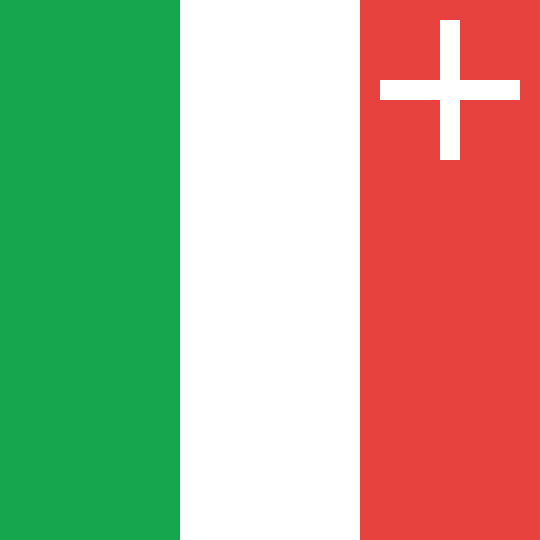
Flag of the canton of Neuchâtel

Questions about Neuchâtel

24 practice questions with answers and explanations on the authorities, history, geography and culture of Neuchâtel. The app has all 417 questions on Neuchâtel and Switzerland.

Neuchâtel publishes an official question bank. Our questions are written by us and complement it. You can find the official question bank on the canton page under “Official documents”.

Tap an answer to see if it is right. Under “Show answer” you find the solution with an explanation and the source.

Politics and the state

What does the flag of the canton of Neuchâtel look like?

Show answer

Correct answer: D – Three vertical stripes, green, white and red, with a white cross

The Neuchâtel flag is a vertical tricolour of green, white and red, with a small white cross in the upper part of the red field. It was adopted in 1848, after the Republic was proclaimed. According to one interpretation, green stands for the mountains, white for the farming area and red for the vineyards.

Source: fr.wikipedia.org · Checked October 2026

In which year was the current flag of the canton of Neuchâtel created?

Show answer

Correct answer: C – 1848

The green-white-red flag was adopted in 1848, shortly after the republican revolution of 1 March. It replaced the old chevron arms of the principality. The white cross recalls membership of Switzerland.

Source: ne.ch · Checked October 2026

Which authority represents legislative power in the canton of Neuchâtel?

Show answer

Correct answer: B – The Grand Conseil

The Grand Conseil is the parliament of the canton of Neuchâtel; it passes laws and the budget. The Conseil d'État is the cantonal government. The Conseil général is the legislature of a municipality.

Source: ne.ch · Checked October 2026

How many members does the Neuchâtel Grand Conseil have?

Show answer

Correct answer: B – 100

The Neuchâtel Grand Conseil has 100 members, elected by the people by proportional representation. Its sessions take place in Neuchâtel castle. The Vaud Grand Conseil, by comparison, has 150 members.

Source: ne.ch · Checked October 2026

History

In which year did Neuchâtel join the Swiss Confederation?

Show answer

Correct answer: C – 1814

Neuchâtel was admitted to the Confederation on 12 September 1814, then confirmed as a canton by the Federal Pact of 1815 and the Congress of Vienna. Together with Geneva and Valais it was among the last cantons to join in the 19th century. However, it remained a principality of the King of Prussia.

Source: ne.ch · Checked October 2026

What historical peculiarity distinguishes Neuchâtel from the other Swiss cantons?

Show answer

Correct answer: B – It was both a Prussian principality and a Swiss canton

From 1814 to 1848 Neuchâtel was both a Swiss canton and a principality belonging to the King of Prussia. It is the only canton to have been both a monarchy and a republic. This situation ended with the republican revolution of 1848.

Source: ne.ch · Checked October 2026

From 1707, which sovereign ruled the principality of Neuchâtel?

Show answer

Correct answer: B – The King of Prussia

In 1707, after the Orléans-Longueville line died out, the principality of Neuchâtel chose the King of Prussia as its prince. Apart from a period under Napoleon (1806-1814), Prussia reigned until 1848. The King of Prussia only formally renounced his rights in 1857.

Source: fr.wikipedia.org · Checked October 2026

On which date was the Republic of Neuchâtel proclaimed?

Show answer

Correct answer: D – 1 March 1848

On 1 March 1848, republicans coming notably from Le Locle and La Chaux-de-Fonds took Neuchâtel castle and proclaimed the Republic. Since then 1 March has been a public holiday in the canton. This revolution ended the Prussian monarchical regime.

Source: ne.ch · Checked October 2026

Geography

What is the capital of the canton of Neuchâtel?

Show answer

Correct answer: C – Neuchâtel

The capital of the canton is the town of Neuchâtel, on the lake of the same name. The Grand Conseil and the Conseil d'État sit there, in the castle. La Chaux-de-Fonds and Le Locle are the main towns of the Neuchâtel mountains.

Source: ne.ch · Checked October 2026

Into how many regions has the canton of Neuchâtel been divided since the districts were abolished in 2018?

Show answer

Correct answer: B – 4

Since 1 January 2018 the six former Neuchâtel districts have been replaced by four regions: Littoral, Montagnes, Val-de-Ruz and Val-de-Travers. These regions are used mainly for statistics and planning. The canton lies in the Jura Arc.

Source: fr.wikipedia.org · Checked October 2026

Which of these is one of the four regions of the canton of Neuchâtel?

Show answer

Correct answer: A – Val-de-Travers

The four Neuchâtel regions are Littoral, Montagnes, Val-de-Ruz and Val-de-Travers. Gros-de-Vaud is in Vaud, Ajoie in Jura and Gruyère in Fribourg. Val-de-Travers is known for absinthe and the Creux-du-Van.

Source: ne.ch · Checked October 2026

How many municipalities does the canton of Neuchâtel have in 2026, after many mergers?

Show answer

Correct answer: B – 24

Since 1 January 2025 the canton of Neuchâtel has had only 24 municipalities (as of 2026), compared with 62 in 2008. The latest merger created the municipality of Laténa (Hauterive, Saint-Blaise, Enges and La Tène). The canton is one of the most active in Switzerland in merging municipalities.

Source: rts.ch · Checked October 2026

Approximately how many inhabitants does the canton of Neuchâtel have?

Show answer

Correct answer: B – about 180,000

The canton of Neuchâtel has about 180,000 inhabitants (180,302 at the end of 2025). The main towns are Neuchâtel and La Chaux-de-Fonds. It is a medium-sized canton by Swiss standards.

Source: latele.ch · Checked October 2026

Society and everyday life

Which cantonal service coordinates integration policy and conducts naturalisation interviews in Neuchâtel?

Show answer

Correct answer: B – The Service for Multicultural Cohesion (COSM)

The Service for Multicultural Cohesion (COSM), created in the 1990s, coordinates the canton's integration policy. It also fights racism and discrimination and offers interpreting services. It questions naturalisation applicants on their knowledge of Switzerland.

Source: ne.ch · Checked October 2026

Which document is given to everyone who settles in the canton of Neuchâtel when they register with the residents' office?

Show answer

Correct answer: B – The Citizenship Charter

New residents receive the Citizenship Charter, a set of information documents about the canton. It presents the foundations, principles and values of the Republic and Canton of Neuchâtel. It is a basis for 'living together'.

Source: ne.ch · Checked October 2026

In the Neuchâtel naturalisation interview, what is the minimum number of correct answers required out of the 16 questions asked?

Show answer

Correct answer: B – 10

The Neuchâtel oral questionnaire has 16 questions, 4 per theme (geography, history, politics and society), with at least one per theme about the canton. At least 10 correct answers are needed to pass. Partial answers count as wrong.

Source: ne.ch · Checked October 2026

Everyday life

What is the name of the public transport company of the canton of Neuchâtel?

Show answer

Correct answer: D – transN

transN is the Neuchâtel public transport company: it runs buses, regional trains and funiculars. The tl operate in Lausanne, the TPG in Geneva, and Mobilis is the Vaud fare network.

Source: ne.ch · Checked October 2026

At what age does compulsory schooling begin in the canton of Neuchâtel?

Show answer

Correct answer: A – 4

In the canton of Neuchâtel compulsory schooling begins at age 4, with two years of kindergarten. It lasts eleven years, in line with the HarmoS agreement. Public school is free of charge.

Source: ne.ch · Checked October 2026

Economy

What is the flagship industry of the canton of Neuchâtel?

Show answer

Correct answer: D – Watchmaking

Watchmaking is the emblematic industry of the canton of Neuchâtel, especially in the mountains (La Chaux-de-Fonds, Le Locle). The canton is also active in microtechnology and research, for example with the CSEM. Many watch brands have their headquarters there.

Source: ne.ch · Checked October 2026

Which federal office has its headquarters in Neuchâtel?

Show answer

Correct answer: A – The Federal Statistical Office (FSO)

The Federal Statistical Office (FSO) has had its headquarters in Neuchâtel since the late 1990s. It produces Switzerland's official statistics, for example on population. The SEM and the FOPH are in the Bern area.

Source: fr.wikipedia.org · Checked October 2026

Culture

Why are La Chaux-de-Fonds and Le Locle UNESCO World Heritage Sites?

Show answer

Correct answer: B – For their watchmaking town planning

Since 2009 La Chaux-de-Fonds and Le Locle have been UNESCO World Heritage Sites for their watchmaking town planning. Their grid-pattern streets were designed for watchmakers' needs, with plenty of light in the workshops. Both towns also have watchmaking museums.

Source: ne.ch · Checked October 2026

Which famous architect, whose real name was Charles-Édouard Jeanneret-Gris, was born in La Chaux-de-Fonds?

Show answer

Correct answer: B – Le Corbusier

Charles-Édouard Jeanneret-Gris, known as Le Corbusier, was born in La Chaux-de-Fonds in 1887. He is one of the most influential architects of the 20th century. Several of his early works, such as the Maison blanche, are in his home town.

Source: ne.ch · Checked October 2026

What is the largest festive event held every year in the canton of Neuchâtel?

Show answer

Correct answer: D – The Fête des Vendanges

The Fête des Vendanges (Grape Harvest Festival) takes place every year in Neuchâtel at the end of September. It celebrates the end of the grape harvest with a big parade and many events. The Escalade is a Geneva festival and the Fête des Vignerons is held in Vevey.

Source: ne.ch · Checked October 2026

Which Neuchâtel region is considered the birthplace of absinthe?

Show answer

Correct answer: A – Val-de-Travers

Absinthe, nicknamed the 'green fairy', was born in the Val-de-Travers at the end of the 18th century. Banned in Switzerland from 1910 to 2005, it is now legally produced again. It is part of the region's identity.

Source: fr.wikipedia.org · Checked October 2026

All questions by topic

The test also includes questions about Switzerland as a whole. Practise them by topic: